PHOTOGRAPHY & THE LAW
Ethics in photography are the principles that help and guide us in how we take and share photographs. The word ethos by a dictionary is defined as the set of moral beliefs, attitudes and habits that are characteristic of a person or a group.
People not allowing for differences outside of an ideal. Is this "ideal" real or fake? Allowing only type of beauty can lead to insecurities, then can lead to psychological issues especially in young people who are easily influenced.
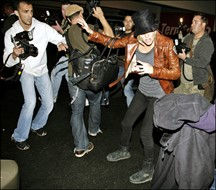
Privacy is the right to a normal life without the invasion of privacy. It is a very serious problem among movie and sport stars. Many of them are treated as products. Are we guilty in buying the magazines – Princess Diana's death was a tragedy - are we partly responsible? The thirst for celebrity no privacy rights in public places
[Press image depicting the actress Sienna Miller]
The right to private moments of emotion is very important, consent should be asked first. The rights of people on the street to remain anonymous however, public places are public, it is not against the law to take photographs. But permission may be needed in certain situations. By making an image then publishing it, it may not tell the whole story and may be classed legally as harassment. It is sad but there are no privacy rights in public places.
[Photo by Henri Cartier-Bresson]
Privacy is an issue in moments of extreme suffering. Is it morally right to take pictures whilst people are dying? It raises many questions. Does the photographer have a duty to report back to the rest of the world about horrors? Does the image tell the whole story? Do people have a right to anonymity when vulnerable?
[Photos by Horst Faas]
Exploitation makes a photographer famous. The subject is not paid, even though the image is world famous. The audience may have empathy with the subject for example, 32 year old Florence Thompson – “Destitute pea picker in California” – 1930s Great Depression “icon of resilience in the face of adversity”. And the audience may relate themselves to the subject.
[Photo by Dorothea Lange – ‘The Migrant Mother’]



Photography is protected by the law through copyright. Photography can be restricted by the law when identified as a criminal offence.
Copyright means the person who creates the photograph, owns the photograph for up to 70 years after the photographer’s death. Plagiarism is copying without permission for example, scanning or any copying without permission is against the law.

This sign means no photography unless authorised at events. Photography at tourist attractions may be forbidden by the owner.
Photography on private property generally open to the public is usually OK, but can be forbidden by the owner, for example in a shop. Permission is needed from landowners. There are no privacy rights in public places, except in places where privacy is expected in a bedroom or bathroom.
It is OK to photograph children, consent should be asked first, but can’t be suggestive or pornographic.

Landowners and property owners can restrict access and forbid photography on private property. However, it is legal to photograph private property from a public street. Health & Safety issues may forbid photography. Consider safety and permission for your own shoots.

Using or distributing of software like Photoshop that is copyrighted is against the law. The software license gives the user rights to use the software on a computer or number of installations only. Unauthorised copying is forbidden. The owner must accept terms of the license to use the software.